This applies to almost all gates and railings. In a perfect world. it is ideal to have a centre bar to work from. This makes it easier to produce an attractive pattern. But this is not always possible, it will depend on the size of the gate or railing. If you are using the cheaper fixed space 100mm method, getting a centre bar is not always possible.
With a centre bar.
When a centre is present, most designs are based on a mirror image of the left and the right, with the centre bar being where the mirror line is.
As a first example i am going to use a railing designed to fit a 1700mm gap. With the ladder having 400mm space between the horizontal bars. Further down i will show examples of what to do without a centre bar.
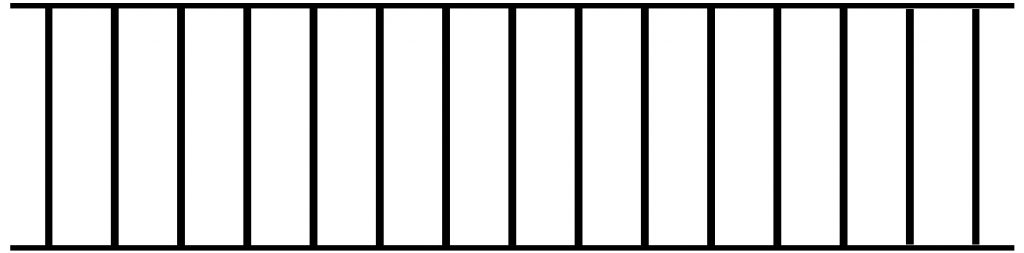
Completely plain with upright bars no top decoration, based on the 100mm gap between bars system. With an upright bar count of 15. being an odd number of bars we know there is a centre to work from.
For the purpose of this exercise, i am going to use two pre-made parts. A basket and a ring, i could have chosen almost anything.
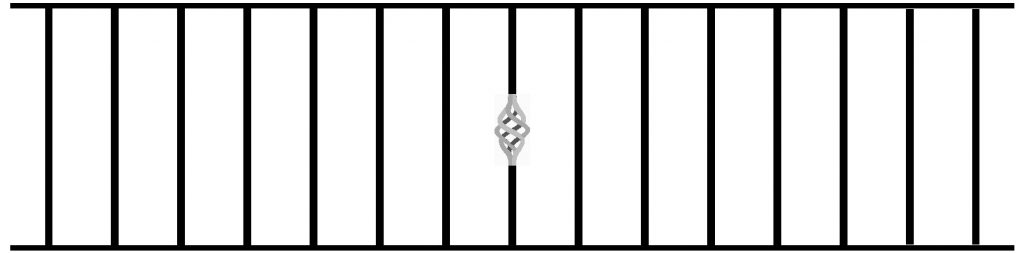
The most obvious start would to be to place something on the middle bar. A single basket might be enough for your design needs. After all it could be highlighted in gold to make it stand out from the black railing.
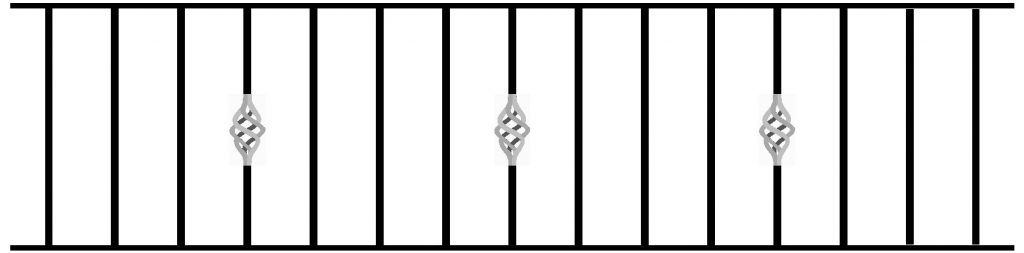
Assuming it is not enough detail for your taste. you can then count out from the centre and place a second detail. As this panel has 15 bars i counted out 3 plain bars and placed the basket on the fourth bar to the right of centre and the fourth to left of centre. What ever way you count it you have three plain bars and detail on the fourth bar. All very symmetrical but that’s what usually makes it look pleasing. Taking the centre bar an having the left and right as a mirror image of each other.
Three bars (i will refer back to this strange statement later)
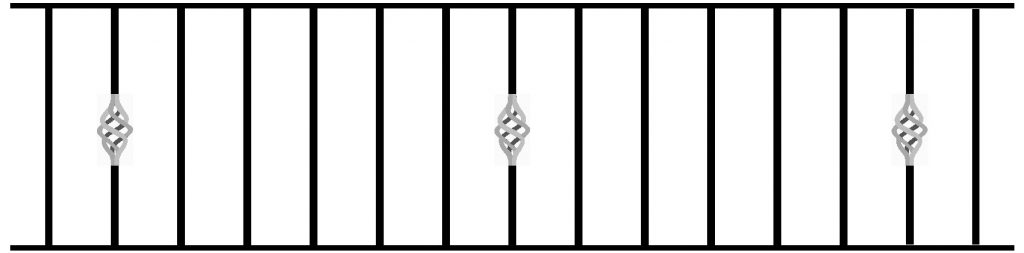
Still only 3 parts used here but the “outer” baskets have been moved towards the end of the railing.But it does change the look of the railing.
So placement is important, as it changes the look of any design.
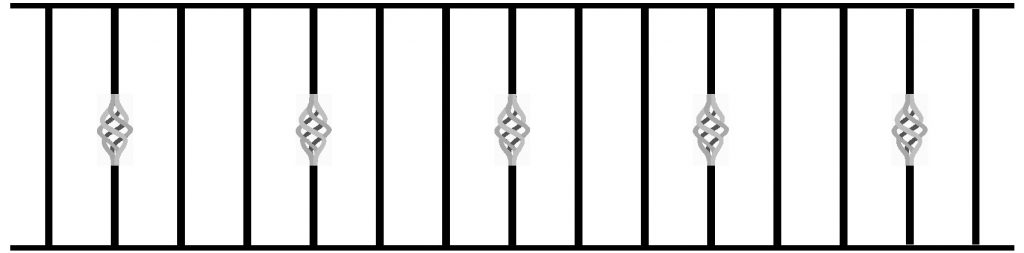
Assuming three parts is not enough detail, you can add more detail or more parts. But as you add more parts, The ability to position them becomes more limited. This the only option that works. Every third bar, on a railing this size you don’t have the option to try every fourth bar as the last basket would be “off” the railing.
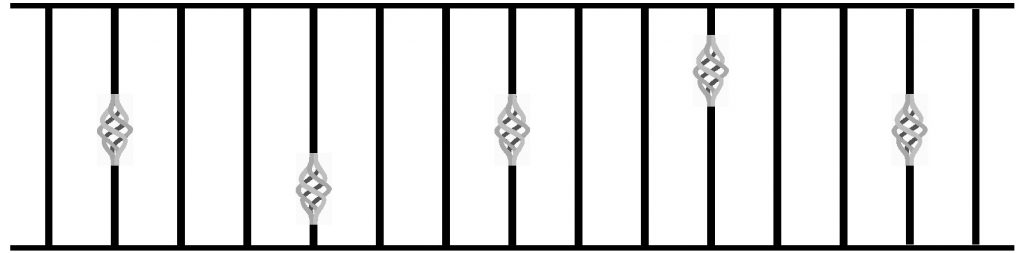
Assuming you have the height, you can “mess” with the vertical position. This adds an extra dimension to the possibilities of design. Although this design is not mirror imaged from the centre bar. It still has a nice look to it.
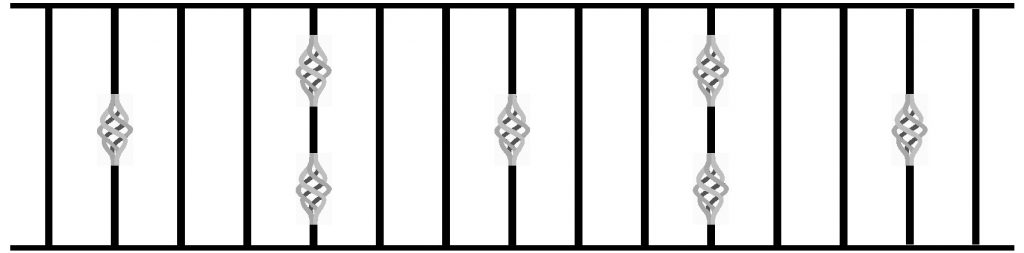
Again this assumes you have the height. But you can stack more than one part on a bar. On taller railings like a patio railing you might get away with stack 4 parts on a bar.
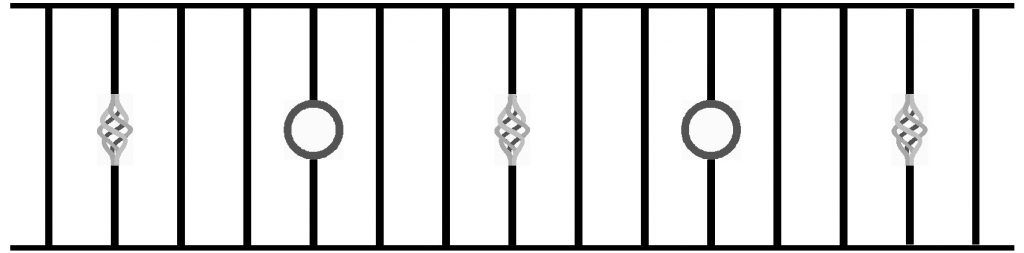
Up to this point, only Baskets have been used. Alternating parts, here baskets and rings changes the design.
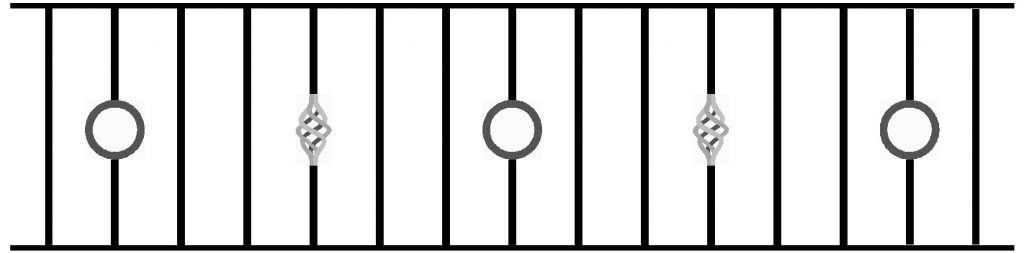
Nothing new here, with the exception that instead of the basket being the centre bar. The circle is now the centre. An alternative universe version of the same railing
There is perhaps no reason why if you had two railings, the same size next to each other. That you can not have them as alternate. One with circle as centre bar and one with cage as centre bar.
Assuming three panels in a row, again you could “mix n match” choosing one as the centre panel, and use the alternative universe versions as the left and right of centre version. It really is personal choice.
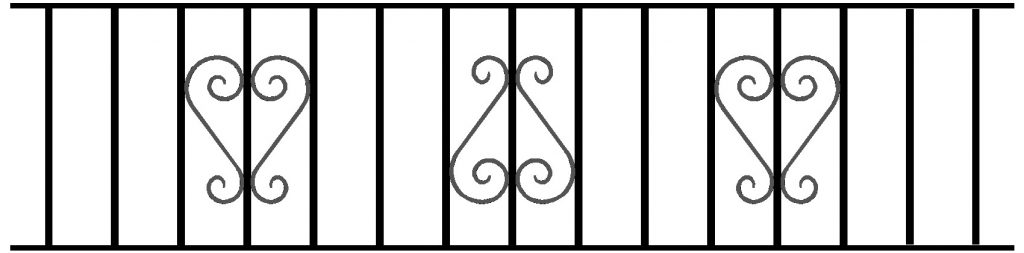
Referring back to where i said three plains on the third drawing.
Despite the scrolls being in exactly the same position as the cages. The spacings are wrong. It works for the cage but not the scrolls.
A scroll spans three bars. meaning if positioned the same as the basket you on have one plain bar not three. The correct position for the outer scrolls would be to move them out one bar from the centre than their current position.
But its also useful to point out as drawn, scrolls can be “flipped” up or down. The correct way up for them is the one you prefer.
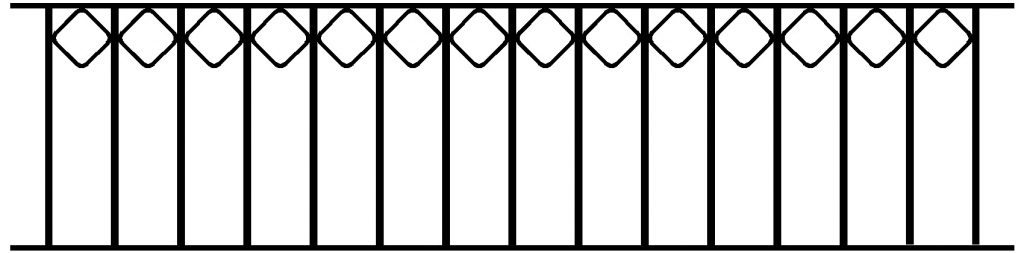
This is squares but it could easy be circles. At the top it becomes possible to use parts to fill a gap between bars. The restriction being is that you can’t go to the end. it has to be as drawn.
Attempting to cut part of a circle or detail in, will foul with the wall fixings
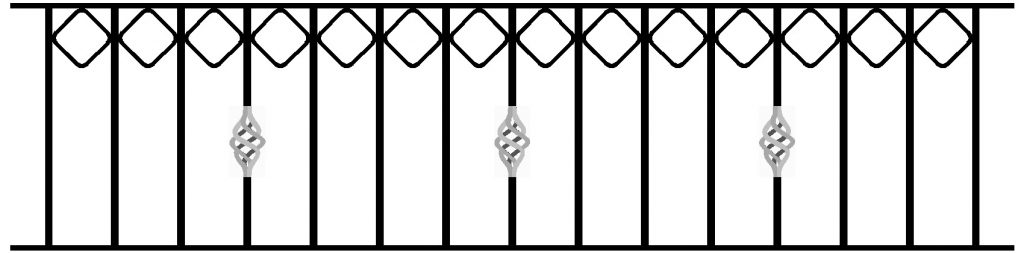
It is possible to use the top decoration of squares as infill and create a pattern in the vertical uprights. Bear in mind that top detail takes 100mm out of your available space. Of course now to make your cages look centred within the bar they are now welded in off centre.
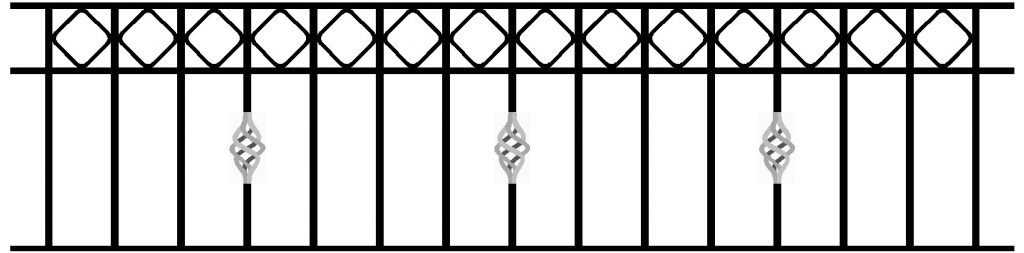
There is no reason why the top detail is not contained within an extra horizontal bar. This was the tradition way of doing it. The above version was a cost saving way of getting a similar result, without the need to use extra material and weld in an extra bar.
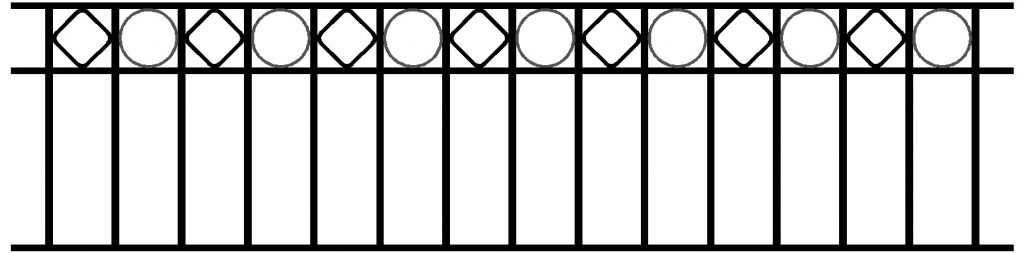
Perhaps pointing out the obvious here. There is no reason why you can not use an alternating pattern, as an infill between gaps. Or that infill could be at the bottom rather than the top.
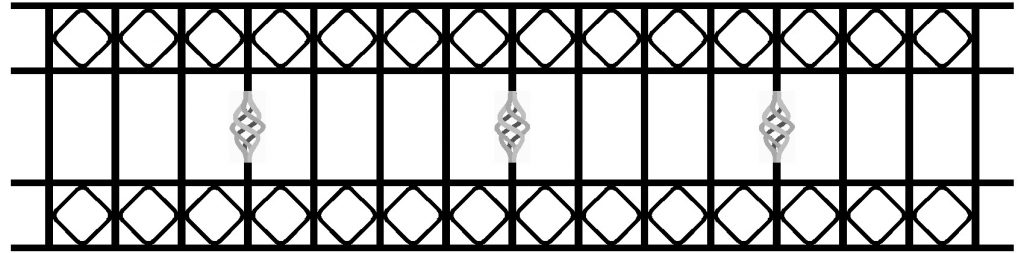
Again there is always the option for those that can’t decide top or bottom, to have both. As you can see here in a short railing. It sooner eats the space up. But these railings are only drawb as 400mm between horizontal bars. Taller railings like juliet balconies or patio railings give a much larger space to play with.
Just to point out even though you are using the centre as your “mirror” point, it does mean you have to have a bar with detail in the centre. A plain bar is fine.
Without a centre bar.
With no centre bar things are a little different. you can no longer work from a centre bar outwards.
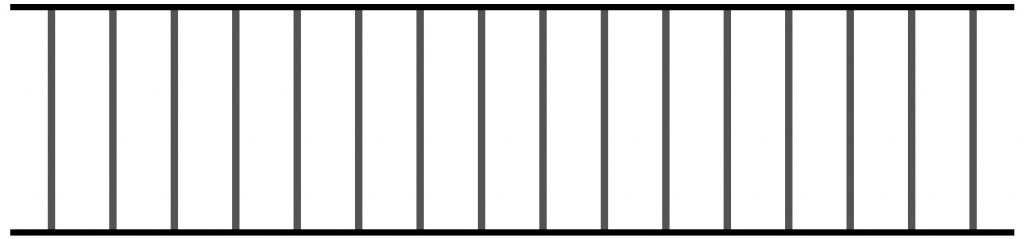
1800mm long, results in no centre bar. But that isn’t a problem, nice designs can still be made.
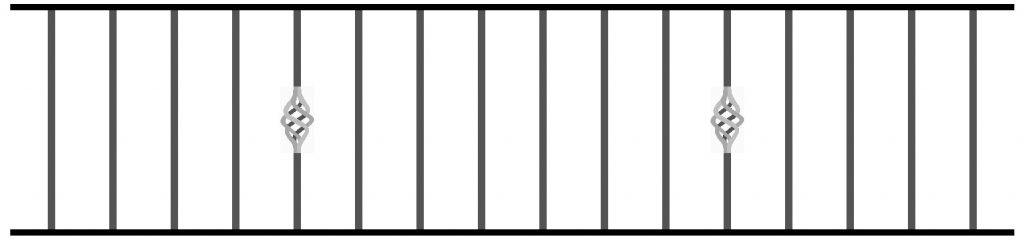
You are still in effect working from the middle outwards, but you have a centre gap rather than a centre bar. So keep things looking symmetrical it is ideal to work from that point.
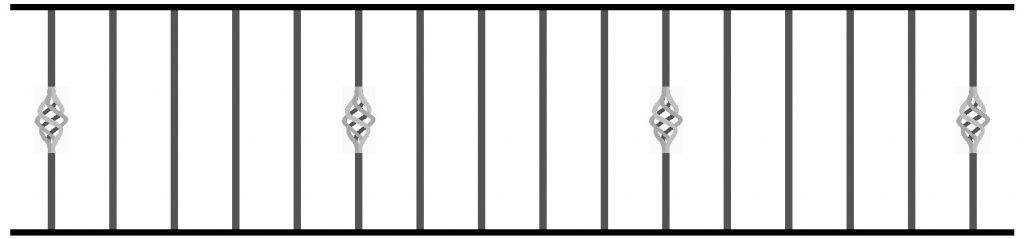
Because the bar count works nicely, it is possible here to have detail, then 4 plain bars followed by detail. but this would always depend on the number of bar in railing.
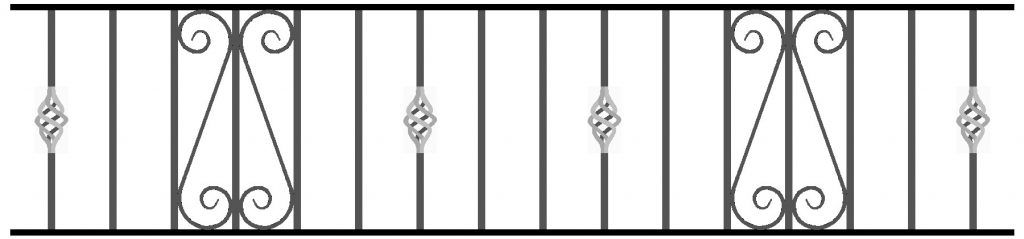
This pattern again works because of the bar numbers. on a smaller railing say 1600mm this wouldn’t really work, as the end two bars would be missing. Adjusting the baskets 1 space closer to the scrolls would allow the whole pattern to fit.
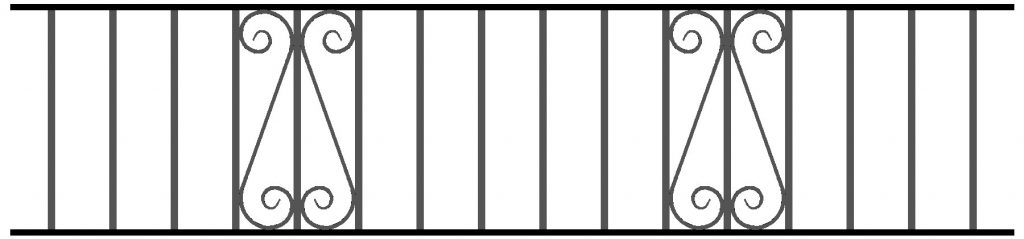
As simple pattern like this is not so dependant on bar count.
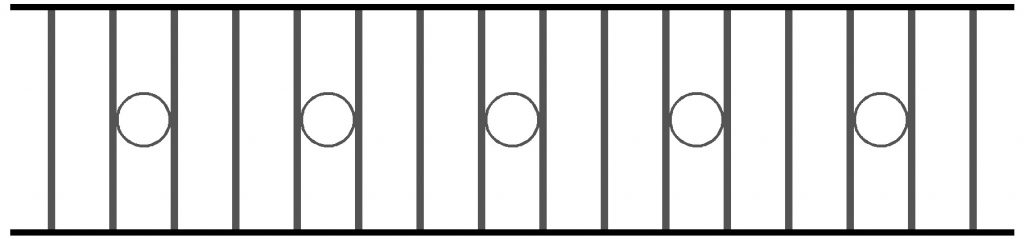
Of course when you use gap fillers like a circle, you have a centre gap
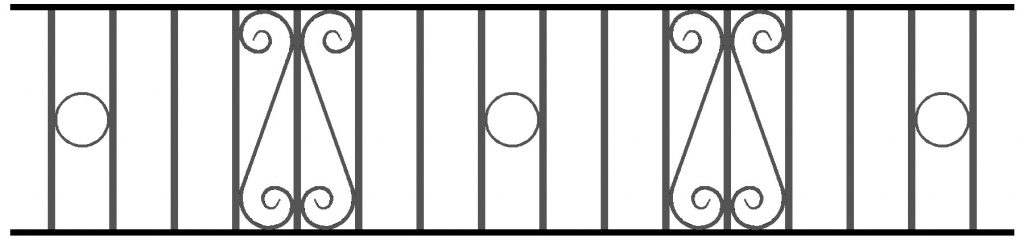
Centre fillers and scrolls
Conclusion
Whilst i could spend countless hours drawing different designs, it has become obvious that designs will vary depending on size. For every design there needs to perhaps 15 versions for different sizes. At least covering 1200mm to 3000mm long, which is where the vast majority of railings will be in size. 10 designs becomes 150 drawings. Factor in to that different heights and 10 designs can become 450 drawings. Lets be honest 10 different designs is nothing compared to what can be achieved. We are most certainly talking 100 plus, far to much time needed to put all the size variations on a website. when it could easily be 30.000 different drawings.
The whole purpose of these design tutorials was to allow you to design you own. Obviously i have access to a CAD program, allowing drawings to be made easier to do. The majority of you reading this wont have that luxury because of the cost. Obviously by designing your own, we are sharing some of the work load. You are paying me to make not design and make. So i don’t have to factor in design and drawing time to the cost of a gate or railing.
I suspect some of the people reading this section of the website, might even have access to a welder and will be tempted to make their own. Others will be to far away from me to be able to help as only work “Locally” to the Gatwick area. Either way you should be able to make use of the info here, to design and make your own. Or design and take that design to someone local to you and get them to make it. Getting a better price because you have done the design work.